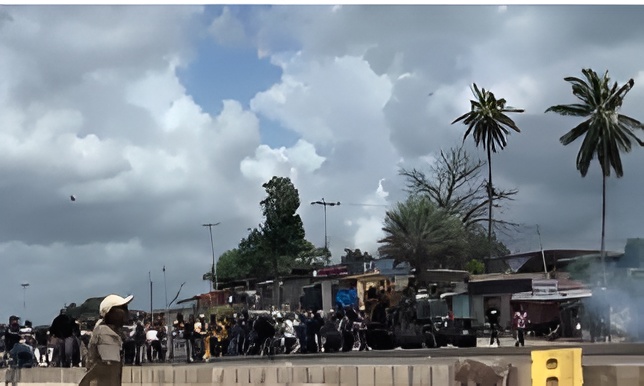
Traders in Dar es Salaam are now counting millions in losses after election-day protests turned violent across Tanzania.
What began on Wednesday as calls for electoral justice quickly descended into chaos, leaving businesses destroyed, roads barricaded, and communication crippled by an internet shutdown.
Artists and traders alike lament the destruction and government restrictions that have paralyzed daily life.
What began on as a call for fairness in the polls quickly degenerated into chaos, with demonstrators setting fires, blocking major roads, and targeting businesses in frustration over alleged electoral injustices.
Businessman Paul Boniface shared his frustration on social media, saying the government’s decision to restrict internet access amid the unrest has worsened the crisis.
“I’m using a VPN because the internet is shut down. This has greatly affected our operations. Work has completely stopped due to unstable connectivity,” said Boniface.
Traders estimate losses in the millions of shillings, with shops vandalized, glass windows shattered, and goods looted in multiple neighborhoods.
The violence, which erupted a day after Tanzanians went to the polls, hit hardest in areas such as Kimara, Magomeni, Ubungo, Kinondoni, Shekilango, and Tandale in Dar es Salaam.
Similar reports of unrest emerged from Arusha, where part of the Prevention and Combating of Corruption Bureau (TAKUKURU) wall was set ablaze, and several public facilities, including Bus Rapid Transit (BRT) stations and polling centers, were damaged.
Eyewitnesses described scenes of chaos through the night as protesters clashed with police.
“We could hear explosions and shouting until morning,” said a resident of Kinondoni. “Shops were burned, and people ran for safety.”
Several police stations were also targeted during the unrest, leading to heightened security deployments throughout the city.
Beyond physical destruction, Tanzania’s vibrant creative industry has also been hit.
Reports indicate that some artists’ businesses and studios were vandalized, prompting outrage among citizens who accused entertainers of remaining silent while the country faced turmoil.
“These are the same artists who endorsed the President but said nothing as the country burned,” one user wrote on X (formerly Twitter), echoing growing frustration among young Tanzanians.
Political tension in Tanzania has been building for months leading up to the October 29, 2025 elections.
The race for the presidency, contested by 17 candidates, including three women, was overshadowed by the disqualification and detention of major opposition figures, among them Tundu Lissu, who has reportedly been held since April on treason charges.
The absence of key opposition leaders sparked anger among supporters who felt robbed of a fair contest.
By election day, demonstrations erupted in defiance, reflecting what many described as long-simmering resentment over limited political space and lack of transparency.
In a show of solidarity, Ugandan opposition leader Bobi Wine publicly supported Tanzanian protesters, saying, “It’s time for African leaders to listen to their youth.”
Posting on X, he declared he stands with detained opposition leader Tundu Lissu and urged regional leaders to respect the voices of Generation Z demanding change.
“The youth of Africa are speaking. It’s time for leaders to listen,” Wine wrote, capturing the broader regional sentiment toward democratic reform.
President Samia Suluhu Hassan, expected to retain power in the 2025 election, faces growing scrutiny over her handling of dissent and the economic fallout from the unrest.
While authorities have yet to release official figures on damage or arrests, the scale of destruction paints a grim picture for traders trying to rebuild amid lingering uncertainty.
As businesses count their losses, residents are urging calm and calling for reconciliation. “We just want peace so we can get back to work,” said trader Asha Mwenda from Magomeni, surveying the debris of her burned stall.
With internet restrictions still partially in place and heavy police patrols on major roads, Dar es Salaam remains tense, a city waiting for calm after a day that shook Tanzania’s post-election stability.































Comments
Sign in with Google to comment, reply, and like comments.
Continue with Google